LMU Munich, GermanyCollaborate With Us
Space Weather Munich logo
Space Weather Munich
11 June 2026

Plasma Observatory recommended for ESA mission selection

ESA has proposed to its Science Program Committee that Plasma Observatory be selected as the next medium-class science mission. The formal decision is expected at the Committee's next meeting in November 2026.

Plasma Observatory is planned as a seven-spacecraft constellation to study how solar-wind plasma interacts with Earth's magnetosphere, how particles gain energy, and how plasma processes connect across different spatial and temporal scales.

PD Dr Elena Kronberg is part of the Plasma Observatory consortium, contributing expertise in magnetospheric plasma physics, energetic particles, and multi-spacecraft observations.
19 May 2026

SMILE successfully launched to explore Earth’s space environment

On 19 May 2026, the ESA-CAS SMILE mission (Solar wind Magnetosphere Ionosphere Link Explorer) successfully launched aboard a Vega-C rocket from Europe’s Spaceport in Kourou, French Guiana. The mission will provide the first global observations of how the solar wind interacts with Earth’s magnetosphere and drives space-weather activity.

SMILE combines soft X-ray imaging, ultraviolet auroral imaging, and in situ plasma measurements to investigate the large-scale dynamics of Earth’s magnetic environment. One important challenge for the mission is contamination from energetic soft protons, which can enter the Soft X-ray Imager (SXI) optics and increase background noise or potentially damage the CCD detectors.

The LMU Munich Space Weather group contributed to mission preparation through the development of empirical and machine-learning-based models predicting soft-proton intensities along the SMILE orbit. Using long-term spacecraft observations and solar-wind measurements, the group developed models to estimate periods of enhanced proton contamination in the SXI instrument. These models are intended to support shutter-operation decisions and help optimize scientific observing time while protecting the detector system from high-flux proton environments.

SMILE is a joint mission between the European Space Agency (ESA) and the Chinese Academy of Sciences (CAS) and represents a major step forward in global space-weather research and Sun-Earth system science.

4 September 2024

Cluster mission: Salsa's last dance

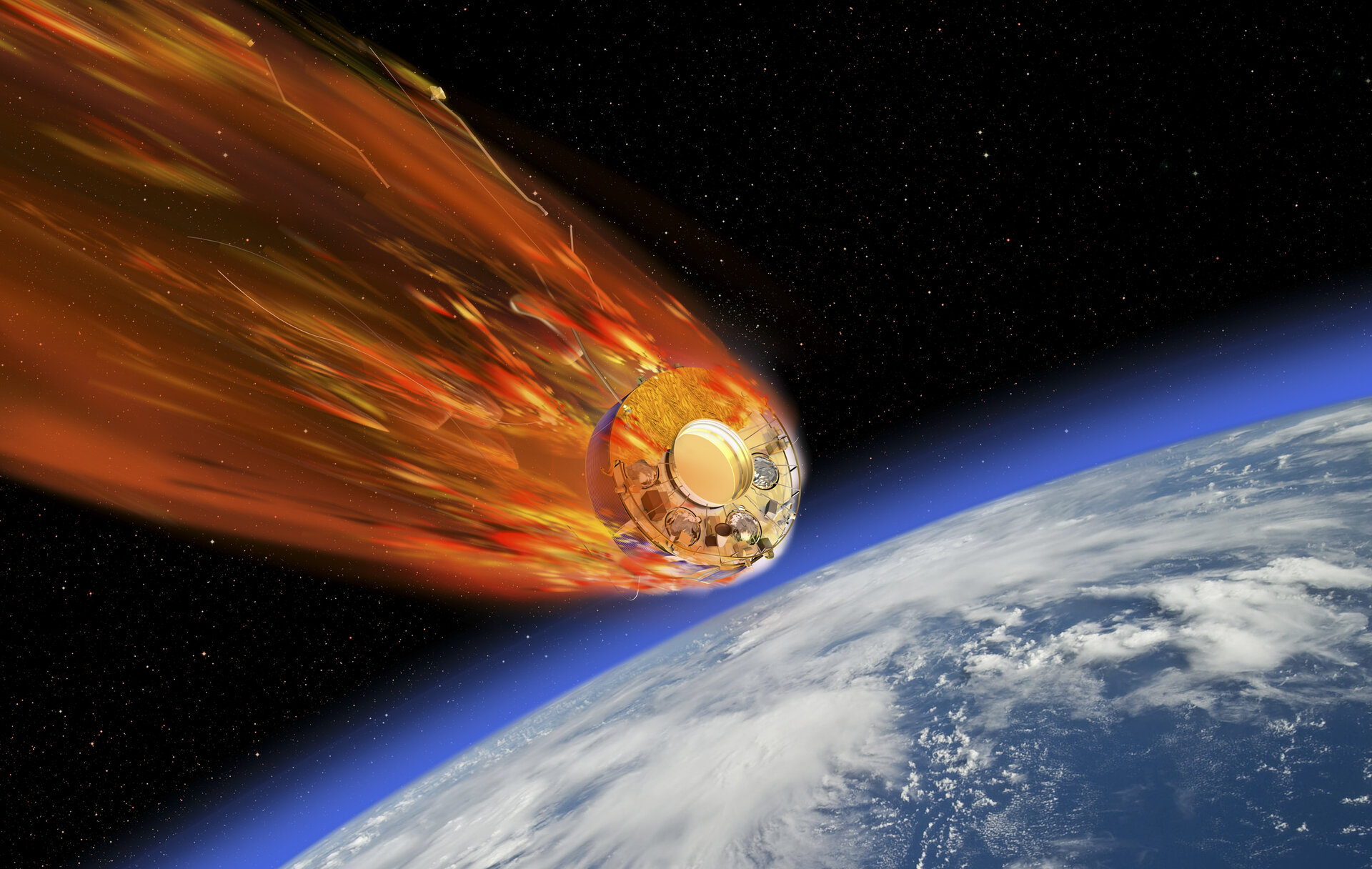
Artist impression of the Cluster satellite Salsa re-entering Earth's atmosphere
Credit: ESA
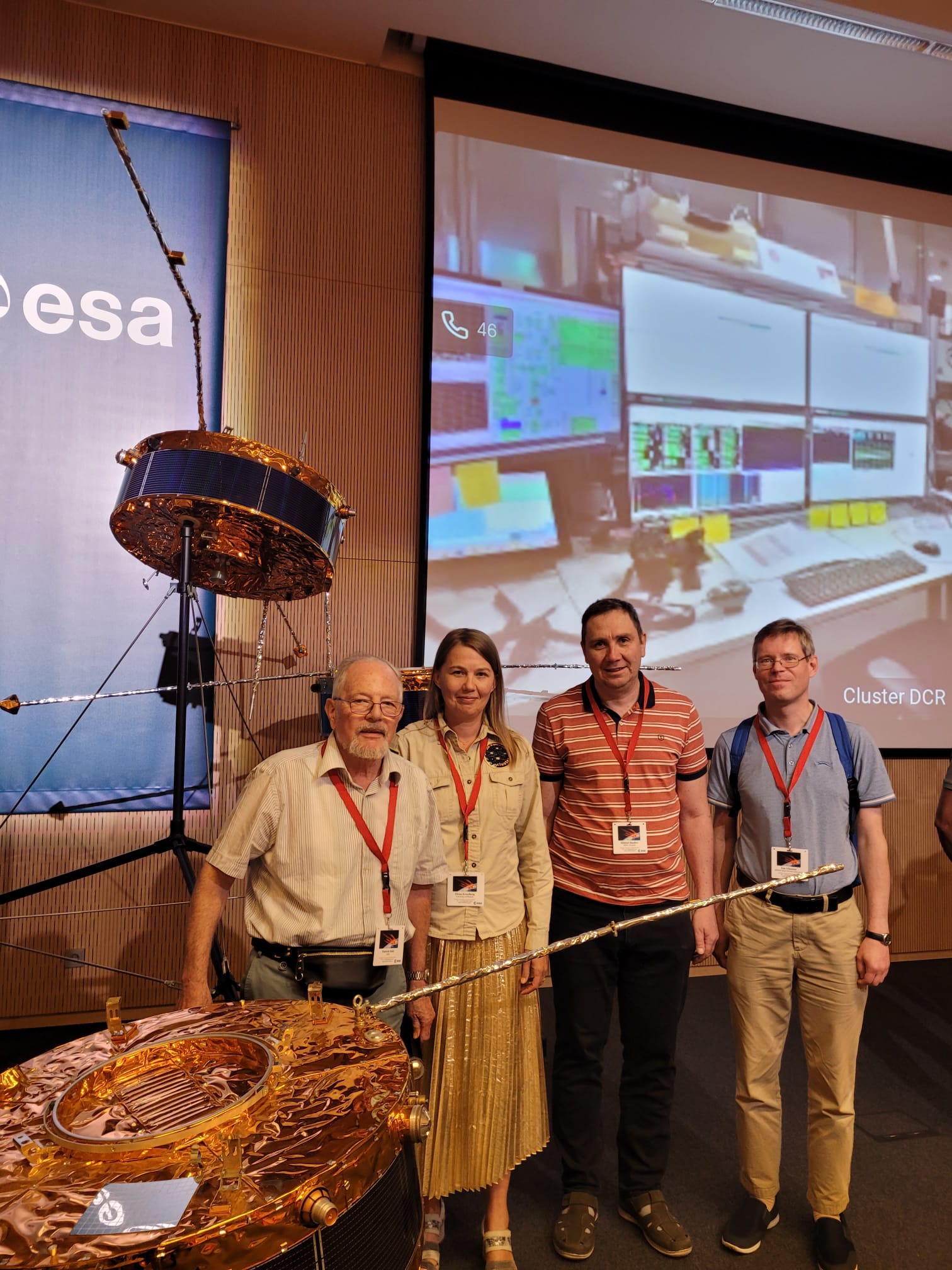
RAPID team members during Cluster re-entry activities
Cluster/RAPID team after Salsa re-entry

ESA's Cluster satellite Salsa re-entered Earth's atmosphere over the South Pacific on 8 September 2024, closing the first chapter in the controlled end of the four-spacecraft Cluster mission after 24 years of magnetospheric observations.

Cluster's four satellites, Salsa, Rumba, Samba, and Tango, provided a three-dimensional view of Earth's magnetosphere through more than two solar cycles. The mission helped reveal how the solar wind compresses, energizes, and restructures the magnetic shield surrounding our planet.

A central part of this legacy is RAPID, the Research with Adaptive Particle Imaging Detectors instrument contributed by the Max Planck Institute for Solar System Research. Elena Kronberg, now leading Space Weather Munich, served as co-PI of RAPID and has used Cluster/RAPID observations to study energetic particles, heavy ions, plasma pressure, and auroral dynamics.

The final re-entry campaign also supports work on how long-lived satellites can be removed from orbit safely and predictably at the end of their missions.

25 March 2024

ESA features LMU research on auroral spiral formation

ESA has published a feature story highlighting recent research from the LMU Munich Space Weather group on the formation of a spiral-shaped aurora observed above northern Norway.

The work originated from a photograph taken by Elena Kronberg during a workshop in Tromsø in 2013, where an unusual green auroral spiral appeared in the night sky. Several years later, the event became the focus of a research project conducted by Katharina Maetschke at Ludwig-Maximilians-Universität München using observations from ESA’s Cluster mission together with NASA’s THEMIS spacecraft.

The study compared ground-based auroral observations with simultaneous satellite measurements in Earth’s magnetotail and found evidence that a spiral-shaped plasma structure was propagating through the magnetosphere at the same time as the auroral spiral appeared above Tromsø. The proposed interpretation is that plasma vortices and magnetic-field disturbances in the magnetotail mapped along magnetic-field lines into the ionosphere, producing the visible spiral aurora.

The publication represents one of the first studies directly linking an amateur ground-based photograph of an auroral spiral with in situ satellite observations from space.

ESA’s feature story also highlights the importance of coordinated observations between citizen scientists and space missions to better understand auroral dynamics and magnetosphere-ionosphere coupling processes.

January 2023

JGR review paper recognized among the most downloaded articles

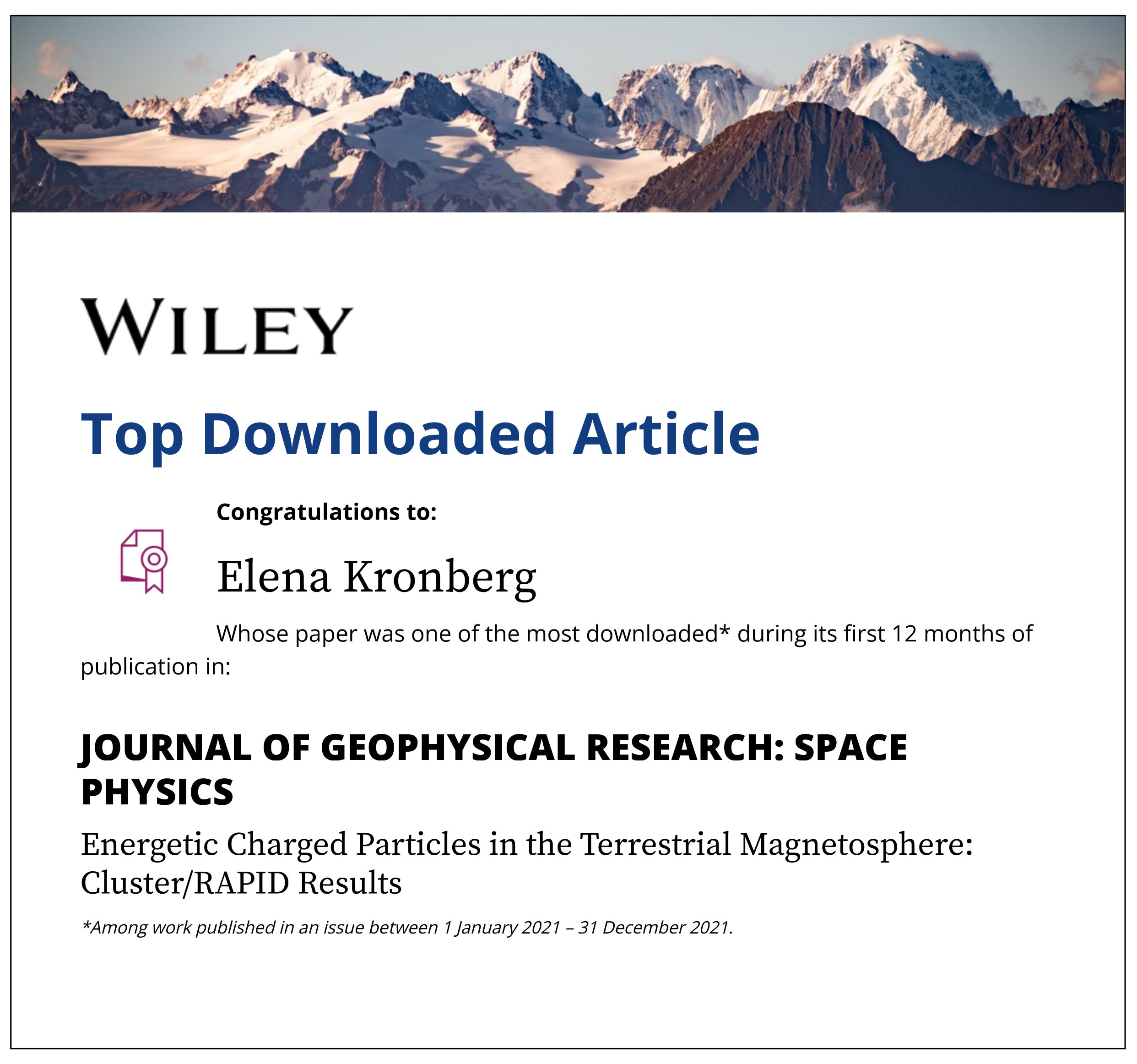
Wiley recognition graphic for a highly downloaded JGR Space Physics paper

The review paper "Energetic Charged Particles in the Terrestrial Magnetosphere: Cluster/RAPID Results" by Elena A. Kronberg and collaborators has been recognized by Wiley as one of the most downloaded papers published in Journal of Geophysical Research: Space Physics during its first 12 months after publication.

The paper summarizes more than two decades of scientific results from ESA's Cluster mission and the RAPID energetic particle instrument, covering topics such as particle acceleration, substorm dynamics, radiation belts, plasma pressure and space-weather effects in Earth's magnetosphere.

The study highlights the importance of energetic charged particles above 40 keV for magnetospheric dynamics and demonstrates that these populations play a crucial role in plasma pressure calculations during geomagnetic storms and substorms. The work also discusses implications for spacecraft operations and soft-proton contamination of X-ray telescopes.